


A week ago, Javier Milei, the president of Argentina, was facing one of his toughest crises since taking office in late 2023.
The dollar rate, seen as a social thermometer beyond its financial weight, was spiraling upward, breaking Milei's agreements with the financial sector and his pledges to voters. Congress overturned his vetoes on laws increasing funding for key public areas, such as health and education. His sister, Karina Milei, was embroiled in a corruption scandal, and his party, La Libertad Avanza, suffered a two-digit loss in the midterm elections to Peronism, his chief rival.
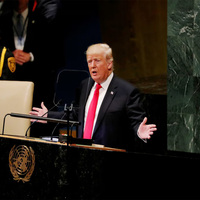
Some of his key allies began distancing themselves. However, President Donald Trump's appearance at the United Nations General Assembly provided Milei with a lifeline, including a reelection endorsement and a pledge from the U.S. Treasury to help bail Argentina out of its crisis.
"The Treasury is currently in negotiations with Argentine officials for a $20 billion swap line with the Central Bank," Scott Bessent, U.S. Treasury Secretary, posted on Wednesday morning. "We are working in close coordination with the Argentine government to prevent excessive volatility."
The U.S. Treasury signaled support for Argentina through bond purchases, standby credit from the Exchange Stabilization Fund and a $20 billion swap line, while working with the Milei government to curb market volatility, end exporter tax breaks and plan post-election debt relief, in a show of strong Trump administration backing.
What the United States will seek in return remains unclear. Local media reported possible demands ranging from contracts for natural resources, including critical minerals, to a strategic push for Argentina to scrap its currency swap deal with China that's currently valued at $18.5 billion.
Some even said it could go as far as allowing U.S. armed forces to operate from Argentine territory.
"They [the Milei government] are handing the economic policy of Argentina to the United States," said Matias Wasserman, economist and analyst in the Observatory of Economic Affairs and Public Policy (OCEPP, in Spanish). "The fact that they haven't said what the U.S. will ask in return is probably in part because it's not settled, but also because they're managing the announcements in instalments to generate positive market expectations."
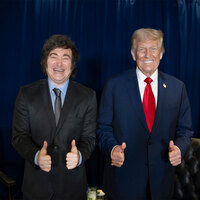
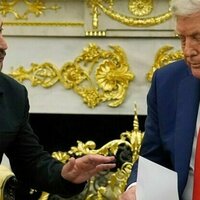
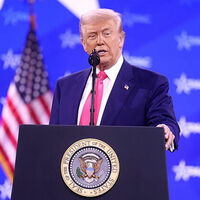
The announcement followed Milei's first bilateral meeting with Trump on Tuesday, after several informal encounters during the U.S. campaign and a personal invitation to Mar-a-Lago following Trump's victory in the presidential race last November. "I'm gonna do something I don't often do - I'm endorsing him," Trump told reporters after the 20-minute meeting, boosting Milei's prospects for a potential reelection bid in 2027.
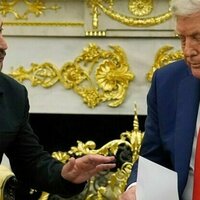
Milei, smiling beside him, held up a printout of Trump's Truth Social post calling him "a truly fantastic and powerful Leader for the Great People of Argentina," "a very good friend, fighter, and WINNER," and offering his "Complete and Total Endorsement for Re-Election as President."
Milei has yet to announce a reelection bid as his party faces next month's national midterms. Some experts told local media they believed Trump may have confused the midterms with the 2027 presidential race.
"Thank you, President Donald Trump, for your great friendship and this extraordinary gesture," Milei wrote on his X account shortly after the meeting.
Argentina and the United States have rarely been close in recent decades, with brief exceptions, such as during Trump's first presidency, when he backed an International Monetary Fund (IMF) loan for Mauricio Macri's government. More recently, though, Argentina has become one of Washington's strongest ideological allies. In return, the Trump administration has supported Milei's austerity-driven political and economic program, which also seeks to roll back many progressive policies of recent decades.
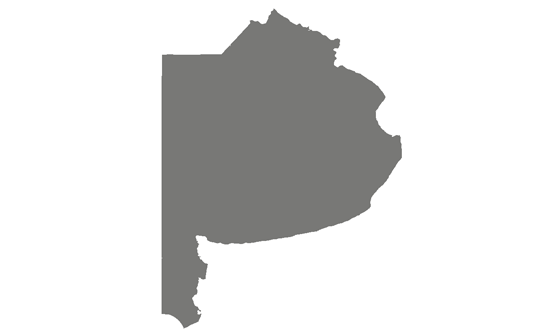
After Tuesday's bilateral meeting, Argentina's country risk fell to 954 points. J.P. Morgan's EMBI+ index closed at 1,023, down sharply from its Sept. 7 peak of 1,516 after Milei's loss in Buenos Aires Province legislative elections.
"The signal that the U.S. Treasury is willing to buy sovereign debt eased concerns over liquidity strains from the current program, and raised the chances of a sharp drop in country risk, potentially opening the door for Argentina to return to debt markets in early 2026," said Federico Filippini, Chief Economist at Adcap Financial Group.
Argentina faces more than $10 billion in International Monetary Fund debt payments next year, with scarce Central Bank reserves and little new investment. After securing a $20 billion IMF loan in April 2024, Milei turned to the Trump administration for further backing.
The Trump administration's move echoed a 1995 rescue of Mexico, when Washington lent $20 billion through the Treasury's Exchange Stabilization Fund, repaid with petroleum revenues as collateral.
The U.S. is the IMF's largest shareholder, with 16.5 percent of voting power - enough to veto major decisions that require an 85 percent majority. Argentina, one of the IMF's largest borrowers, accounts for nearly half of its active lending portfolio and faces billions more in debt repayments in the near future.
Source: Courthouse News Service